Spiders in the Shower

I originally wrote this piece in late July or early August of 2014 (I don’t know the exact date) . The blog where I posted it then no longer exists. Given the current goings-on in Israel-Palestine, it feels important to share these words again.

I keep thinking about the spiders in the shower. The first morning I was at Cedars of Peace in my hermitage cabin set back in the woods, I opened the shower curtain to see a daddy long legs who had inhabited a  low corner of the shower stall. The next morning three spiders had taken up residence. One was hanging with the first spider on the wall opposite the shower head. The other had spun a web in the corner below the shower head.

I chose not to deliberately disturb them (perhaps due to a recent spider massacre via vacuum cleaner I'd carried out in my home), nor did I protect them. One of the new long-leggers was positioned in the line of fire of the water. The other received blows from the water dripping down. Each was pelted beyond their defenses. Each died.

Those spiders have been on my mind all week. I think of them as I hear the rising death toll from Gaza (among other places, but Gaza is closest to my heart) and see pictures of bodies, some living, some lifeless, all brutalized.

I think of my occupation of what had been spider territory. Despite my infringement, I suffered no harm. I'm not sure if I did any harm to the one spider who lived. Did I destroy his home? Perhaps. I couldn't actually see the web. Did I block him from leaving the shower? No. Did I control his access to food? No. This makes me a gentler occupier than Israel (at least until the killing). This year Israel has destroyed 329 Palestinian structures and has demolition orders for many more. I don't believe that number includes the mass destruction going on in Gaza right now. Israel controls what goes in and out of Gaza and the West Bank. That includes food, supplies, and Palestinians. Israel has power over the coming and going of other folks, too, but their control is strongest over Palestinians, who cannot leave Gaza or the West Bank without a permit from Israel and even with the permit, they may be denied at the checkpoint. Many times I've heard the words "open-air prison" used to describe Palestine, and especially to describe Gaza. I've been hearing that in the last 12 days, Israel sometimes gives a warning to Gazans to evacuate an area before they begin bombing or shooting. Gaza is 139 square miles. There aren't too many places to go to escape the violence. Leaving Gaza is not an option.

I think of the power I have solely because I, compared to a daddy long legs, am pretty massive and forceful. I could have easily smashed a spider between my fingers, though I consider myself too civilized to do so. Thanks in part to the billions of dollars in aid the U.S. gives each year, Israel is a mighty power, far, far mightier than any Hamas militants and certainly more powerfully violent than the women and children who are trying to live but instead are dying at the hands of Israeli soldiers. Israel is obliterating any Gazan it chooses.

I think of my easy dissociation from the death of these other creatures of God - it wasn't deliberate, after all - and wonder if it is so easy for Israeli soldiers and Hamas fighters. Was it so easy earlier today for Israeli soldiers to kill a man who, accompanied by international human rights workers, was looking for his family in a bombed out area? They shot him four times, while the others looked on, because otherwise they, too, might be killed. What about the four children on the beach a few days ago?  Or the other 300+ Gazans, many of whom were civilians? Collateral damage, that's all those people are, right? What about the few Israeli soldiers and 2 civilians who have been killed? How easy is it to kill someone, and someone else, and maybe more? How easy is it to recognize a common humanity among all people after doing so? How easy is it to feel one's own humanity after killing a person?

My heart is sick.  It is sick for those who have died. It is sick for those who have fallen into beliefs that make them want to kill or hurt. It is sick for my Palestinian friends who are grieving. One of my former students wrote to me today, "Even the weather was sad."

And so I pray. And so I stand on a street corner in protest and on another in vigil as the names of the deceased Gazans are read...age 6 months, age 75, age 17, age 22, age unknown... And I remember the spiders and the power I have to destroy the life and dignity of God's creation and the power I have to defend it. God help me to choose life, especially human life, and to defend it, even with my own. Always. 

Experiments in Love

The following is the reflection I offered to my beloved church community on this sixth Sunday of Easter (May 9, 2021):

Acts 10:25-26, 34-35, 44-48, 1 John 4:7-10, John 15:9-17

Happy Mother’s Day! Whether this day brings joy because you are celebrating your own mother or you are being celebrated yourself, whether this day brings complicated feelings that may include grief or anger or shame because your experience of being mothered or being a mother has been challenging, may you experience expansive love on this day.

Love, love, love.

Today’s readings include more than a dozen references to love. We are to love one another because God is of love, God is love, we are loved by God and by Jesus.

Love, love, love.

What does it mean to love one another? Before I explore that, I want to briefly highlight a sub-theme.

In the first reading we hear Peter say that “God shows no partiality, but rather, that any person of any nationality who fears God and does what is right is acceptable to God,” a continuation of a theme of inclusion, an expansion of the WE of the early community of Jesus-followers that has run through the readings, and the resulting homilies, of the last several weeks. Both today’s first reading and the gospel reading encourage not only inclusion, but a sense of equality as Peter tells Cornelius to stand because the two are equally human, and Jesus tells his disciples that he calls them friends, rather than subordinates.  So we continue on the path of moving from a ME mentality to WE to EVERYBODY. Everybody in the fullness of our humanity, our dignity, even our divinity. Welcome all. Love all.

I suspect that as you’re listening to these words, many of you are thinking “Yes! Welcome all! Love everybody!” When we talk about these practices at St. William, we often highlight certain groups and enthusiastically affirm our commitment to remembering and loving them, because they are so often forgotten, ignored, dismissed. If you want to join me today, I invite you to raise your hand and, while staying muted on Zoom, saying “Yes” to affirm these commitments:

Love members of our St. William community- Yes!

Love our Black and Brown siblings- Yes!

Love our LGBTQ+ siblings- Yes!

Love our immigrant and refugee siblings- Yes!

Love our siblings across the spectrum of physical and mental abilities- yes!

Love all our siblings who are marginalized in one way or another- Yes!

Love our siblings who stormed the Capitol on January 6-

Wait! What??

If I were tech savvy, I’d insert a sound of a car coming to a screeching halt. I suspect that some of you, like me, have more difficulty raising your hands and saying “Yes!” to loving this segment of EVERYBODY.

I’ll name a few others who elicit the same hesitation from me. Love our siblings who pass laws that amplify inequities and exacerbate needs. Love our siblings who believe owning guns is a God-given right.  Love our siblings who commit, cover up, or excuse abuse of any kind. Love our siblings who do not honor the sanctity of the spectrum of ways that we humans love each other. Love our sibling who was the 45th president. As I speak these words, I notice my body tensing, my stomach churning, and my voice getting quieter. I even struggle to use the word “sibling” in some cases.  I’d prefer to distance myself from these members of EVERYBODY, rather than acknowledging our kinship, our interconnection, and that God loves them just as much as God loves all the people I easily say “Yes!” to.

So back to the question: What does it mean to love one another, and to include everybody in the EVERYBODY?

Love is a practice. It is an ongoing experiment.

Nonviolent or Compassionate Communication is one of the tools I use in my experimentation. In the last year I’ve had the opportunity to share this tool with many people, including juniors at Sacred Heart through a workshop about communicating across divides. In the workshop, I always model a conversation that for me is a challenging one. The example I use with the students is a conversation with someone who says things like “All lives matter! I’m so sick of hearing Black lives matter! Saying that is divisive. White privilege isn’t real. Can’t we just move on? Can’t they just get over it?”

My focus in the model conversation is to connect with the other person, not to argue, or one-up, or prove them wrong, but to connect authentically both in the way I listen and the way I express myself. I ask for a volunteer and say it doesn’t matter to me if the person actually holds that perspective or is role-playing it; my goal either way is the same. Twice I’ve had girls volunteer for whom the conversation was real; the first admitted it, the second didn’t, but it was clear by what she said and how she said it that we were having a real conversation. In those two conversations the stakes were particularly high as I tried even more carefully to practice what I preach.

The Free Listening Project has a quote on their website that says something like “Being heard is so close to being loved that most of us don’t know the difference.”  As I listened to the girls express perspectives that were so different from mine, I worked to hear the deeper messages beneath the words and to reflect back not their words, but the humanity, dignity, and divinity that I was witnessing in their vulnerable, even if challenging, sharing.

These modeled conversations were only 5 minutes long and when the timer rang, I found myself wanting to continue talking to them. It takes time to move from the headspace of “How can you possibly think that/say that/do that?!?” to the heart space of “I am willing to see your vulnerable humanity, the part of you that simply wants to be loved and accepted, and acknowledge your precious divinity, the part of you that is love and acceptance.” Sometimes that movement takes minutes or hours or days. Sometimes it takes weeks, months, years, decades. It’s easier to make the movement in a role play or an anticipated conversation than it is when the conversation comes as a surprise or when I or someone I know has been deeply hurt. When I am able to move into that space, my willingness to acknowledge and expand my understanding of EVERYBODY grows. Practice. Experiment.

Earlier this year I took Loretta J. Ross’s class, Calling In the Calling Out Culture. One reminder she offered that has stayed with me is this: Angry people need more love, not less.

When we are angry, we need more love, not less. When we encounter angry people, can we practice giving them more love, not less? When we see people doing harm, can we remember that hurt people hurt people and practice giving them more love, not less? More understanding, not less? More connection, not less? Can we move from justice models focused on retribution and the idea that harm-doers are beyond redemption toward models of personal and systemic restoration and transformation?   

One of Dr. King’s principles of nonviolence is that “Nonviolence chooses love instead of hate. Nonviolent love is spontaneous... unselfish, and creative.” As we experience the love of God, the love of Jesus, the love of so many who have come before us and surround us now, may we choose to practice love, to experiment with it spontaneously, creatively, and generously with EVERYBODY. 

Love, love, love.

pexels-artem-podrez-5108672.jpg

Honoring the Knowing

Drummers.JPG

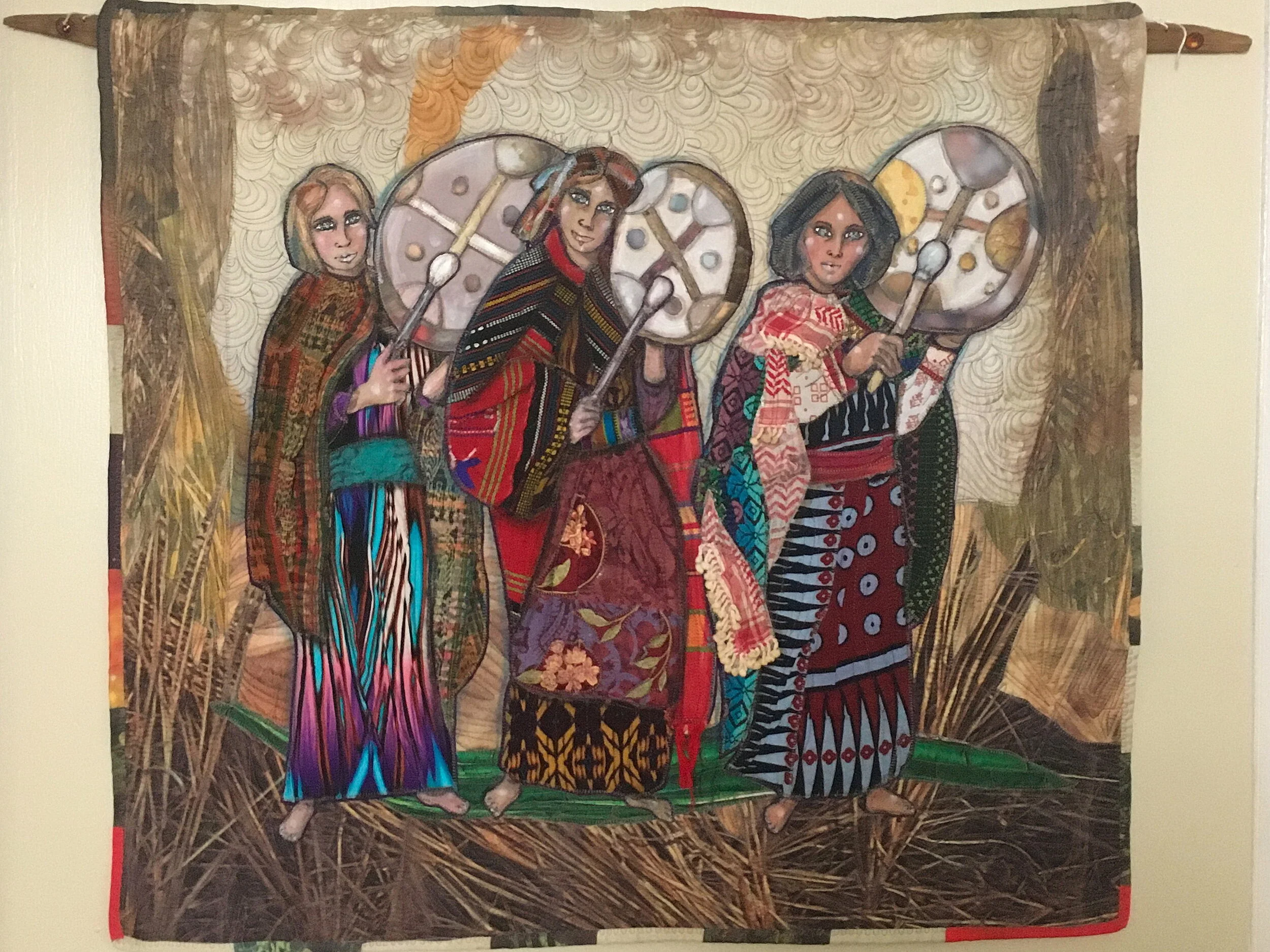
A couple of months ago I welcomed the drummers above, created by Penny Sisto, into my home. Penny is a wise woman and her art, along with being beautiful, amplifies connections to the Divine in ways I often find difficult to put into words. This story is one example I can put into words.

Nearly as soon as I welcomed these women into my home (the story of how they came to be is a story for another day), it became clear that the tapestry of Trayvon Martin that had been hanging above my mantle for years, also created by Penny, was ready to move to a new home. When this knowing came, a brief battle between the logical and intuitive parts of me ensued. It went something like this:

Wisdom: It's time for Trayvon to move on.

The Logical: WHHHHAAAAAT? Are you kidding? Why would I ever get rid of a Penny Sisto piece?

Wisdom: It's time for Trayvon to move on.

The Logical: What will people think when they hear I'm getting rid of a Penny Sisto?

IMG_4165.JPG

Wisdom: It's time for Trayvon to move on. You know who to give him to. It doesn't matter what other people think.

The Logical: GIVE him to?? I'm supposed to GIVE him away? I paid good money for him. And besides, what will I hang over my mantle now?

Wisdom: You know you can't sell him. That would be a dishonoring. You know who to give him to. What is supposed to hang in that space next will come when it’s time.

The Logical: Why do I have to give him up?

Wisdom: You've learned everything you need to from him.

The Logical: WHHHHAAAAAT? I know so little. I have so much to learn still. What will people think if I say that? Who am I to say I've learned what I need to? I’m a white woman. I’ll never have learned enough from him.

Wisdom: You have new teachers. You'll continue to learn. It doesn't matter what other people think. Someone else needs Trayvon now more than you do.

The Logical: Someone else needs him. OK... OK... OK. I'm listening. I'm breathing. I will practice trusting you again. I will pass him on. I know who needs him now.


Wisdom, Knowing, Sophia*, my guide that coaxes me into greater alignment with my deepest values, has yet to lead me astray. When I do wander off the path...so very often...it's because I'm not listening well, I'm not trusting, I'm trying to make logical sense of Mystery.

Wisdom's message that day was so clear that I got it. And so in the days that followed the conversation with Her, I prepared to send Trayvon to his new home. I took him from the wall above the mantle, I cleansed and blessed him with incense. I rubbed a perfumed oil into the wooden piece that held him. I said what I needed to say to him, so that I could give him with with open-hearted joy and delight. I passed him on and he was received with welcome. Any more of his story is for someone else to tell.


For many days after their arrival, the drummers sat on my loveseat just behind where I sit for Zoom calls. This meant I could see them on the screen during calls, see them behind me, supporting me. They were there for weeks both because I wanted them close and because the room they were going to hang in was disordered. I wanted better for them. Finally, a few weeks after seeing Trayvon safely to his new home, I thoroughly cleaned the room waiting for the drummers, moving furniture and lifting up the carpet to vacuum hidden dirt. I removed piles that cluttered the space. I carefully measured the wall and hung them. That they so perfectly fit the space and matched the colors already in the room was no surprise. They were home.

They are home, settling in, and I am settling into their presence. I am not sure what lessons they'll be teaching me, but I am trying to be open. I am also noticing some hesitation. I feel a little shy about getting to know them, even though I already have intimate connections with them.

The first drummer’s cloak is made from a jacket I gave Penny several years ago. It had hung in my closet unworn for years before that, too shabby to wear, too beautiful to simply discard. A Salvadoran friend gave me the jacket in the early 90s. Last year he died of COVID-19. His jacket has found new life not only in this tapestry but in numerous others.

The sleeves of the third drummer came from another item of my clothing, bought in India and worn until it, too, was too ripped to wear. That cloth has also been revived in its repurposing. I delight in recognizing it in new works of art. The third drummer also wears a keffiyeh, a traditional scarf of Palestine. Though the particular fabric in this work has never touched my body, Palestine most certainly has.

The second drummer wears nothing I have worn, but a friend said her energy is similar to mine. I don’t know. I find her just as intriguing as the other two. Someone else suggested that my place with these women is as the fourth drummer. That, too, is still unknown to me.

What I do know is that these drummers will be teaching me for at least the next few years. I hope that I will understand their lessons. Connecting with them is but one way I will continue practicing leaning into Knowing, Wisdom, Sophia.

This practice, and it is a practice, of leaning in, is a part of everything I do. Sometimes I practice well, sometimes my practice falters in small and huge ways. I am thankful for those around me who help me re-ground and re-enter the practice. It is also part of my work to encourage others to lean into Wisdom and Knowing, even if my knowing and theirs seem to contradict one another. In those times we are invited to hold the both/and. I've said many times that I don't want anyone to trust me to the detriment of trusting themselves. So many of us have been taught to ignore, deny, dismiss, disparage, not to trust our Knowing. I don't want to contribute to anyone's mistrust of themselves, their disconnection from Knowing.

Thankfully, it seems that, like me, more people are practicing trust. Experimenting with entering Mystery. Reclaiming Knowing. Re-membering Wisdom. Getting to know Sophia. It is beautiful work. Risky, because She often offers information that doesn't make logical sense, invitations to transformation that don't fit in the systems we live in. But when we trust Her, we can feel the rightness of it settle in our body, grounding us, aligning us, even when it's scary. Aaahhhh...

My wish for you is that you know Her, too. That you recognize Knowing, Wisdom, Sophia within you and that you find places and people with whom to practice trusting.

Blessings,

Cory


*The Greek word for wisdom is Sophia.